We had a beautiful few days in Ottawa, cool and clear. As usual, between concerts and restaurants, our wandering took us into the National Gallery across the Rideau Canal from Parliament Hill. In perusing the galleries of impressionists and the other “ists” of the 19th and 20th centuries and the works of the Canada’s Group of Seven, I had always been tuned into a rich sense of the lives played out in rooms and landscapes in the canvases. But on this occasion, the figures suddenly struck me as revenant spirits, as ghosts in oil. In autumn, approaching All Souls Night, it’s easy to wax elegiac.
The Gallery in Leaf Season
On this crisp autumn afternoon, standing
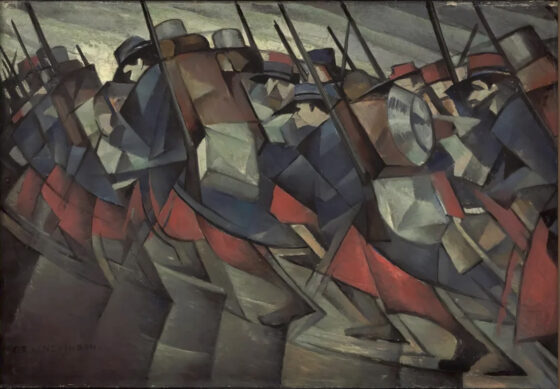
before Nevinson’s Returning to the Trenches—
that Cubist tangle of French infantry marching
with energetic purpose toward the world’s end,
it comes to me that every one might have died
even before the artist’s brushwork had dried–
gassed, shelled, machine-gunned, bayoneted.
But it is not just the soldiers. All through
the gallery, the plump young nudes, the smug
burghers, the children in their Sunday best–
of all that fragile flesh, none of it still lives
outside the framing of daubed rectangles.
And not just the subjects, but the artists, too–
all gone but for the bits left within this room.
I take these thoughts to the Garden Court,
into the Gothic Revival chapel plucked from
the Convent of Our Lady of the Sacred Heart
and born again within secular walls of granite.
Inside, 40 speakers hold disembodied singers
performing Cardiff’s Forty-Part Motet. Once
done, they talk, cough, chuckle and sing it again.
When the train takes me back south, racketing
through falling leaves, through fens and farms
of Eastern Ontario, through the gold of aspen
and birch, the rust of maple, the bronze of oak,
the sky is a bowl of blue porcelain upturned
over the beautiful ashes of the year. What
will remain of me once I am gone from thee?
