I don’t often sweat the big picture. I’m more focused on the small and nearby. But some nights I don’t sleep well and then night thoughts connect the dots for me and I hear the voice of Afrofuturist poet and jazzman Sun Ra say it in his outside voice: “This Planet is Doomed.” All I can say is “Hope not.”
Open Winter
All night the wind worked its way, transforming snow into snowmelt, showing here a patch of muddy soil and there a broken limb of pine.
The tracks that deer left in the yard grow wide as if Sasquatch roamed here. Ice fell from eaves, unremarked, as icebergs calve off from Greenland.
I would say winter gives way, had it ever really taken hold. I worry when the weather goes strange, when the wind chime bells all through the night.
And they say I’m right to worry, not just for this winter in this place, but for all the winters in all the world. Our powers might grow Biblical, but we are no angels.
The West and the North burn each year; in the South what doesn’t drown flies off on the wind. Some say pay no mind–it’s natural, or it’s Jesus, or just in your head.
Assholes. I feel an awful future coming, like an asteroid that dogs Earth’s orbit. It’s more a matter of we know not when, and but a slim chance that we know not if.
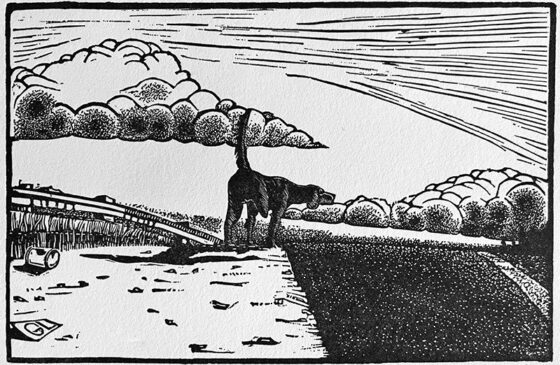
“Three-legged Dog, Two-lane Blacktop.” Wood Engraving by Greg Lago
As I was finalizing selections to include in my forthcoming collection “The Other Village,” my old friend and sometime collaborator, the wood engraver Greg Lago came to mind. He often has since his passing last year. We worked together with printer Jim Benvenuto on a broadside suite of illustrated poems, “On the River,” in the late 1980s. Greg’s Winged Bull Studio in Clayton was the venue for the first reading of my first full-length book, “A Drop of Ink,” which featured those illustrations and poems.
But they were not the only wood engravings by Greg that spoke to me. As the first Gulf War wound down, I wrote a poem to accompany his grim illustration “Officer’s Mess.” And I wrote another to accompany his engraving “The Club Island Boatman.”
Poems that are written about specific works of art are called ekphrastic poems. But Greg’s illustrations are so narrative in character that my poems are not about the piece itself, but tell the stories they evoke, with characters and dialogue absent from the work itself.
One of my favorites, and a good fit for “The Other Village,” follows. It was written when my daughter was in grade school and I was running press at SUNY Canton. It shares the title of the Greg Lago engraving.
Three-legged Dog, Two-lane Blacktop
Half-blind, half-deaf, gray-muzzled and three-legged, the black lab’s still game, a weathered monument to canine kind, homely, sociable,
a match for the flannel-jacketed, ball-capped coot, the rotted pick-up and sway-backed farmhouse, as if a call was sent out to Central Casting.
But they’re real folks, just neighbors, good for gossip and a cup of Joe. The lab delivers a slimy ball back to my daughter, regular as a clock while we chat.
His amputated gait is amazing quick, as if another leg would be surplus. When he starts to tire, he makes the girl chase. His sly smile slobbers.
The old man humors my know-it-all ways, seeing how I used to be a college boy before I was a dad. Besides, he’ll tell you he’s had worse for neighbors, at length,
give chapter and verse, with scatological refinements honed over seventy-seven years of fine grudge-making–an oration splendid in its way as the King James Bible.
But the dog has heard it all before. He has his own bones to pick. He goes to the roadside, tail at point. If God loves old dogs, he’ll bring down another speeding out-of-state sedan.
A change from the usual–a little short fiction that arose as a prolonged daydream I had while I should have been counting my breaths as a novice meditator during my first three-day sesshin at the zen center.
The Tenzo Teaches Baka to Sit
Baka had come to the monastery as a promising young man, recommended to the abbot by his village priest, and within a few years he had progressed well along the dharma path, quickly memorizing all the daily sutras and meal chants, always showing proper respect for his elders and demonstrating compassion for the least of beings. He carefully carried spiders out of the dormitory and he kept a keen eye out for ants and bugs when sweeping the walkways. He chanted the morning service with great nen and was able to sit still for long periods in the zendo with a quiet mind.
But as his practice developed, he began to notice the behavior of others, that they would become fidgety, that they relied on the sutra book to get through morning service, that they sometimes bunked off from work practice to look at girls. Some snuck food into the dormitory; some drank sake late at night.
It seemed to Baka that he was the best of the lot–the most sincere, the most dedicated of all his brothers. The jikijitsu never had to hit himwith a stick. Baka would return to the zendo for extra zazen after the day’s schedule was complete. He would sit sometimes for half the night alone in the hall, not moving a muscle.
Baka began to take over the heaviest jobs, digging out boulders to expand the garden plot, hauling firewood from halfway up the mountain. His brothers seemed pale and puny in comparison.
One day the tenzo came out of the kitchen as Baka was rolling yet another boulder off from the edge of the garden. Baka was happy that one as venerable and respected as the abbot’s friend, the man responsible for the community’s physical well-being, was observing the quality of his work practice. But the tenzo just smiled and shook his head, then returned to chop vegetables for dinner.
Another time, as Baka struggled under a huge load of hardwood he had cut up in the high forest, the tenzo again came out, smiled and shook his head as Baka went by.
The tenzo was old, near to ninety. He walked with a stick. He grunted when he sat down and he farted when he stood up. It was said he had a weakness for shōchū, which made him sing and then fall asleep. So, who was he to shake his head at Baka’s efforts?
Nursing his grievance, Baka’s mind wandered so much during the abbot’s teisho on the koan ” Nansen Kills the Cat,” that he failed to answer “hai” when called on by name. The tenzo, sitting on the other side of the dharma hall, smiled and shook his head.
Baka sat again late in the zendo, but found no peace. He had watched two visiting Tibetan monks once as they engaged in dharma combat, a ritual debate on the meaning and import of the sutras. Inside Baka’s mind he and the tenzo argued like that for half the night.
Finally, Baka went to the tenzo to ask him why he was so dismissive of his sincere and strenuous effort. The tenzo pointed out that a little more garden space had been needed, but Baka had dug up more land than they would ever plant. And he pointed out that the woodshed had been filled weeks ago, and that the wood Baka was cutting now would sit out in the rain and rot before it could be used. “Do just what is needed. Maybe work less, maybe do nothing sometimes,” the tenzo suggested.
Thinking of his many extra hours in the zendo, Baka considered that he might be the best at doing nothing, too. So, he challenged the tenzo to see which of them could sit zazzen the longest without getting up from the zafu. To Baka’s surprise, the tenzo accepted, and set the contest to begin the next day after morning service.
That morning they remained in the zendo while everyone else went on to breakfast, served for once by the tenzo’s assistant. They walked to facing places. The tenzo laid his walking stick by his zafu and they both turned to bow to the Buddha on the altar, then turned and bowed to their zafus, then turned again and bowed to each.
Baka dropped into a perfect half-lotus position in one smooth move onto his cushion. The tenzo grunted and slowly ratcheted himself down to his cushion, cracked his neck from side to side, rolled his shoulders, shifted his head back on his neck, went still, and then broke into a smile.
For the first hour nothing happened, same for the second, same for the third. Every now and then, a curious face would peek around the edge of the zendo doorway. The tenzo never moved, only kept up a serene smile.
In the fourth hour, Baka began to feel a little discomfort in his knees. After a while that began to fade, but in the fifth hour he began to feel some itching. He refused to scratch.
The tenzo just breathed in and out, unmoving except for that slight rise and fall, holding up his small smile like a flower. Hour by hour the day passed as the two sat and sat and sat. Baka’s bladder was complaining, but he would not listen. Little daggers of pain poked the small of his back. He could no longer feel his feet.
He kept his face stony and still as darkness fell, but his mind was jumping like a flea, responding to alarms from one part of his body or another, feeling resentment at the effortless stillness of the tenzo, feeling anger at his unbroken smile.
In the feeble flicker of the altar candle, the tenzo’s face appeared old one moment, young the next, plain as a fart one moment, an ethereal beauty the next. Baka blinked and suffered on through the endless night.
When the monks came in just before dawn, panting from running a fast kinhin around and around the outside of the zendo, they found the pair still sitting. Baka croaked that he couldn’t get up, couldn’t unbend his legs. He asked the jikijitsu to push him over onto his side to rest until feeling returned to his lower body.
The jikijitsu then pronounced that his old mentor, the tenzo, was the victor, and asked if he needed any help in rising. The tenzo’s smile was sweeter than ever, but he made no answer, having returned to the wheel of rebirth sometime in the middle of the night.
The abbot came in to pay respects to his old friend and told the monks, “Yes, I knew he was dying. He said he wouldn’t last much into spring. But he said he still had some teaching to do. He said Baka was sincere and hardworking, but that he couldn’t get out of his own way. But who knows? In 20 or 30 years, he told me, Baka might be fit to make the soup.”
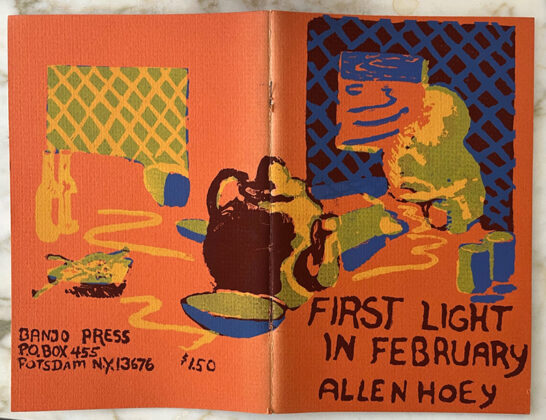
Cover: First Light in February, Allen Hoey. Artist: Paul Davison
Aside from writing my own books, I love to conceive, design and print other books. I’ve done this for love and for money over the years, but this is where and how I first got the bug.
First Light in Broad Street
Waking before dawn to make the coffee, I see from the dimming stars that for once we’ll see sun. And there it rises, a glancing hot spot on the snow of early February, a buttery glow upon the pines.
Having worn a long-sleeve purple tie-dyed tee shirt to bed, it’s no wonder I am reminded of you back when we first met. Half a century ago we were very young and were held in thrall to our many desires.
We wanted to be famous writers. We wanted to stop the war. We wanted an epic love. We wanted to live together with all our friends and make a little art and a little revolution. We wanted a sky-high life.
The bunch of us moved into a ramshackle house at the low-rent end of a middle-class neighborhood and shoveled out the debris left by previous tenants who ran a crisis hotline into the ground and blew town.
Their sense of psychedelic decor took a dark turn. Behind the refrigerator was a mural–a set of stairs led down to where a dark figure wielded a flaming sword. A black wall, when primed, bled demented acid poetry.
So we made ourselves at home. I figure we each lived on three dollars a day–one dollar for rent and utilities, one dollar for food, and one left over for everything else: beer, dope, art supplies, toilet paper, underground comics.
Two semesters of the writing workshop had left you with poems enough to make up a little chapbook. With freedom of the press belonging to them that own one, we decided to publish it ourselves under our own label, Banjo Press.
The name was taken from a Steve Martin routine where he demonstrated on his banjo why it was that you couldn’t play a sad song on one. We may have been high at the time, but the corner we turned then turned into the rest of our lives.
Paul made the illustrations: a rail line curving off into the dark, a drinker leaning on a pinball machine, a barroom panorama with a pool table in use at the back, a man in a room papered with grinning stretcher bearers, a hungover man with coffee.
The cover we printed in-house, a multi-color silkscreen that Paul painted on the mesh with tusche and glue. We hung clothesline in the kitchen and took turns squeegee-ing the ink onto paper and hanging each sheet to dry before the next color went on.
A man sits at a table with a mug, a single window behind him. A teapot wraps around to the back where bowls, a full ashtray and last night’s empty bottles stand. Below the art runs title and author, “First Light in February,” Allen Hoey. On the back, $1.50.
By February, anyone with sense has had enough of dark, short cold days, of being mewed up inside walking the same floors. But into this February day a little light has come, the first sun, warm on my face as I stand at the window, remembering you.
Photo: Austin Kirk, Creative Commons, some rights reserved
You know how it is when you are going along a road you drive every day and you top a rise just as late golden light floods the long valley ahead. Sometimes a glamor is cast over the ordinary world, and in that moment, the light shines right through you. You might cling to such a moment, if only you could.
Freezing Rain Satori
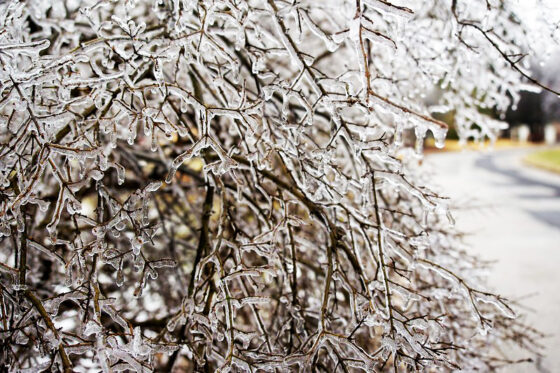
It makes no sound in the night, the freezing rain, as it thickens on twig and needle the way you dip a wick over and over ’til it waxes into a candle.
Then, when morning breaks clear, all the candles are set ablaze. The lilacs that bow to the ground shimmer; look how the bent pine boughs shine.
Such a profligate abundance of light I blink to see. Just this yard, just the world, but all transformed, if only for a little moment before the rain returns.
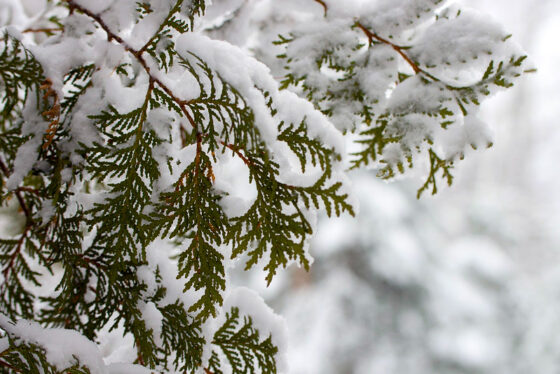
Snow on cedars. Photo: Greg Marks, Creative Commons, some rights reserved
I profess to not be a fan of winter, dreading its coming all fall. But I forget its allure, its beguiling purity and clarity until one morning it suddenly transforms everything.
Epiphany Snow
The first real snow falls on Epiphany, late, after a dry fall and cool December. Six inches, no big deal, but an epiphany nonetheless.
Snow boots are still in the closet, the shovel and salt tucked behind stuff on the back porch. The inevitable finds me unprepared as usual.
I purged from memory the scraping of the plow, forgot the way snow shines on sagging cedars, how all things dull and dim can now be shining.
Out of the old year’s ending, this new beginning, when what could be wrestles with what will be. Who can say what may befall once the snow begins to fall?
The weight of the world distorts the space-time-continuum. Photo: Rossi pena, Creative Commons, some rights reserved
After 911, I remember a child psychologist stressing how important it was, when children were watching the Twin Towers fall over and over again in the media, to explain to them that it only happened once and was not still happening. In cyberspace, the towers are still falling and will always be falling, everywhere, and so too with every other trauma. This is what makes it such fertile ground for obsession.
An English Major Laments the Space-time Continuum
Science fiction writer Ray Cummings explained time thus: “Time is what prevents everything from happening at once.” Physicist John Wheeler added as a capper: “Space is what prevents everything from happening to me.”
This tidy structure we left behind, preferring one where the old rules don’t apply–cyberspace. There, everything that ever happened happens now and what happens anywhere, happens everywhere.
In the old world the body inhabits, this is insane, but in the new world the mind has colonized, this is the allure, to savor every blinking meme, preferring pixels to food, water, love and nature.
Posted inPoetry|Comments Off on An English Major Laments the Space-time Continuum
All kinds of music gets stuck in the top of my mind: pop tunes, carols, hymns, blues. I walk to their refrain for half a day, then pass on to something else. But some music wraps around the brain stem, permeates the convolutions, gets in there for keeps.
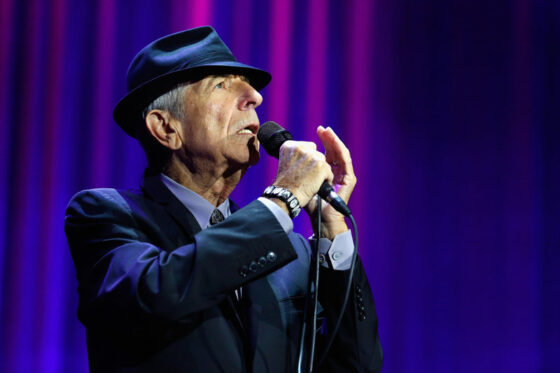
No Cure for Leonard Cohen
His songs dig hooks into memory– deep, dark, rich, complex as chocolate, but unsweetened by sentiment.
Transcendence and despair do duets, celebration and regret. Beauty sheds her merely pretty clothes; pain uplifts.
Behind one devastating line, the heart is hid. His half-destroyed voice demands it: Chase the holy; seek it in the broken.
Posted inPoetry|Comments Off on No Cure for Leonard Cohen